Fault & Contested Divorces
There are several types of contested divorce in France. All follow the same court procedure and can be converted into an uncontested divorce at any time. You can divorce even if your spouse refuses.
Divorces on the grounds of adultery, for instance, often begin as contested proceedings. A spouse who discovers infidelity is rarely inclined to engage in constructive dialogue to rebuild the marriage or to immediately pursue a non-adversarial separation.
Under French law, divorce is a legal right, and a spouse can petition for divorce even if the other spouse does not agree to the breakdown of the marriage. In such cases, the process becomes a contested divorce. The same applies when the future ex-spouses disagree on the consequences of the separation.
There are three types of contested divorce: divorce for fault (divorce pour faute) / divorce by acceptance of marital breakdown (divorce accepté) / divorce for definitive alteration of the marital bond (divorce pour altération définitive du lien conjugal).
Filing for Fault-Based Divorce - Including Adultery
Grounds for Fault-Based Divorce
Divorce for fault is the most contentious judicial procedure. It is invoked when a breach of the marital obligations established by the French Civil Code has occurred (respect, fidelity, support, assistance, and cohabitation) and is asserted by one spouse against the other.
- Spouses owe each other mutual respect; any form of domestic violence is strictly prohibited under French law.
- Fidelity consists of refraining from cheating on one's wife or husband.
- Support and assistance entail the obligation to provide for a spouse's needs. This is not purely financial; each contributes through their work to material support within the household, as well as moral support in all life situations.
- Finally, cohabitation requires living together under the shared marital roof.
Consequently, infidelity, harassment, persistent insults, and domestic abuse can serve as grounds for a fault-based divorce petition. These grounds are subject to judicial interpretation and evaluated in context: in this type of divorce, faults are highly circumstantial. An act of adultery may not necessarily be deemed a legally compensable fault by the Family Court Judge (JAF).
In theory, abandoning the marital home prior to the preliminary hearing was historically considered a fault. In practice, judges rarely penalize a spouse for leaving the family residence when cohabitation has become unbearable. It is often preferable to leave the home rather than remain at all costs and escalate conflicts. A fault divorce is granted either with exclusive fault assigned to one spouse, or with shared fault, depending on the judge's assessment.
Why File for a Fault-Based Divorce?
A fault divorce procedure pursues two primary objectives:
- Obtaining judicial recognition that one spouse has been wronged by the other,
- Having the court adjudicate the consequences of the divorce.
1) Obtaining Judicial Recognition that One Spouse is the Injured Party
The petitioner in a fault-based divorce seeks a ruling declaring the divorce solely to the exclusive fault of the other spouse. It must be understood that in France, winning a fault divorce holds primarily psychological value. Moreover, fault proceedings are burdensome and emotionally taxing, as both parties exchange mutual accusations. Each party must simultaneously present claims and defend against counterclaims.
The strategic advisability of pursuing fault-based grounds must therefore be thoroughly weighed with your lawyer.
2) Adjudicating the Consequences of Divorce
Just like other contested divorces, once the issue of fault is decided, the judge rules on all practical arrangements of the divorce, including:
- The wife's continued use of the husband's surname after divorce
- The amount of compensatory allowance (prestation compensatoire)
- Child custody and residence arrangements
- Sharing of child maintenance and education expenses
Further questions also arise concerning the division of marital property and the allocation of the marital residence.
Compensation / Damages in Fault-Based Divorce
Judicial recognition of fault by the Family Judge (JAF) provides a psychological milestone to turn the page and formally identify the responsible party. Surprising though it may seem, a spouse found at fault may still be awarded a compensatory allowance. Fault no longer impacts the calculation of the compensatory allowance or the calculation of child support / alimony. Fault-based divorces have declined sharply according to Ministry of Justice statistics.
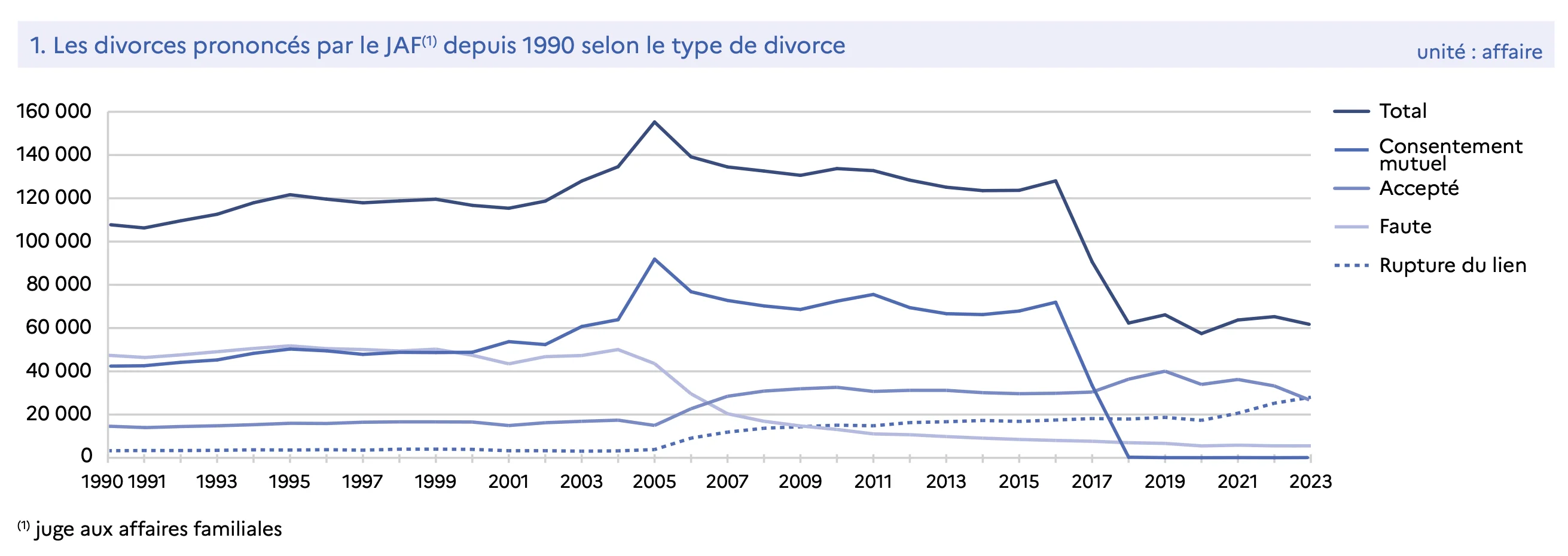
Evidence presented to the court does not always conclusively prove the alleged wrongs, and the statutory criteria for obtaining damages are strictly circumscribed. Article 266 of the French Civil Code provides that:
Damages may be awarded to a spouse in compensation for consequences of exceptional gravity suffered as a result of the dissolution of the marriage, either when that spouse was the defendant in a divorce granted for definitive alteration of the marital bond and had filed no cross-petition, or when the divorce is granted to the exclusive fault of the other spouse.
Fault grounds do not affect ancillary divorce rulings (except in extraordinary circumstances). Thus, a spouse may be judged solely at fault (for instance due to infidelity) yet still receive a substantial compensatory allowance from the "victim" spouse. Financial consequences of divorce are completely decoupled from fault.
Today, rulings assigning exclusive fault are rare. In 2023, fault-based divorces accounted for only 9% of Family Court decisions, compared to 46% for definitive alteration of marital ties and 44% for accepted divorce. Damages awarded are generally modest, ranging from €1,000 to a few thousand euros. This amount must be weighed against the legal fees and average duration of fault proceedings (frequently exceeding two years).

Me QUÉTAND-FINET knows her court well

Other Contested Divorces
Accepted Divorce
For spouses who agree on the principle of divorce and wish to avoid litigating faults committed during the marriage.
Definitive Breakdown of Marital Ties
For couples living separately for more than one year (formerly 2 years) where emotional and physical cohabitation has ceased.
Divorce by Acceptance
Also referred to as divorce by acceptance of the principle of marriage breakdown. At the initial hearing before the JAF, both spouses agree to waive any debate regarding potential faults committed during the marriage. Only the ancillary consequences of the divorce will be adjudicated by the Family Court Judge. This can serve as a stepping stone towards an uncontested mutual consent divorce. This procedure cannot be chosen if one spouse is under legal guardianship or conservatorship.
Once the formal acceptance protocol (procès-verbal d'acceptation) is signed, spouses cannot reverse their decision on appeal to demand a fault-based divorce.
Definitive Breakdown of the Marital Bond
This route is available to couples who have been separated in fact for more than one year (statutory period reduced from 2 years under recent reform). Separation in fact means that cohabitation has ended-they no longer live under the same roof-and emotional ties are severed. Geographical distance due to an expatriate assignment, for instance, does not constitute legal separation if emotional ties remain intact. As with fault-based divorce, it is sufficient for only one spouse to request the divorce for proceedings to commence.
In theory, the duty of fidelity remains until the divorce is final. In practice, the gravity of any fault is substantially reduced-if not non-existent-once spouses are demonstrably separated in fact.
You must gather documented evidence of actual separation (e.g., individual lease agreement for a new residence, formal police declaration of departure from the marital home, utility bills...).
How Contested Divorce Proceedings Unfold
All three forms of contested divorce follow the same procedural sequence: summons / preliminary hearing / formal writ of summons / procedural preparation phase (mise en état) / final trial hearing / judgment. Importantly, at any point during contested divorce litigation, procedural bridges allow parties to convert their case into an uncontested divorce by mutual consent, which is faster, less adversarial, and less costly.
How Much Does a Contested Divorce Cost?
Legal fees for contested divorce proceedings vary. Some attorneys charge on an hourly basis, while others offer flat-fee packages. Our firm prioritizes flat-fee arrangements, providing financial certainty and peace of mind for spouses already dealing with the emotional stress of separation. In return, clients are asked for full cooperation to ensure maximum efficiency throughout the case. No hidden charges for file setup or photocopies are applied.
On the other hand, bailiff (commissaire de justice) fees and court mediation costs are billed directly by those professionals. If you instruct an attorney not admitted to the local Judicial Court's bar, postulation agency fees will also apply.
Various Practical Matters
When should you leave the marital home?
In theory, it is advisable to wait for the judge's interim measures order authorizing separate residences. In practice, it may be necessary and preferable to relocate immediately if the home situation becomes untenable.
When can you resume using your maiden name?
You never legally lose your maiden name. A married surname is merely a customary name (nom d'usage). You may resume using your birth surname at any time.
Can you communicate with your future ex-spouse's lawyer during divorce?
While you may initiate contact, professional ethical rules strictly prohibit an attorney from communicating directly with an opposing party who is already represented by counsel.

By Claire Quétand-Finet Family & Divorce Lawyer - Versailles Bar Association
PhD in Private Law · +10 years of experience in family & divorce law · University Lecturer for continuous legal expertise
See also:
Asset division during divorce - Sole or joint custody - Appealing a Family Court ruling
Need Legal Assistance?
Contact us for a confidential consultation regarding your situation
Request a Consultation