Liquidation of Marital Property
and Asset Division
Divorce often impacts your standard of living. But who gets what? The division of assets is an unavoidable legal step, requiring all marital property to be settled.
To organize this division (termed liquidation of the matrimonial regime), a French notary or your attorney audits the accounts and divides the couple's assets, properties, and debts.
As your attorney, Me Quétand-Finet vigorously defends your financial interests throughout this asset liquidation process.
Asset Masses to Divide According to Your Matrimonial Regime
Division of Pre-Marital Assets
Except in the specific regime of Universal Community (communauté universelle), assets acquired prior to the marriage are personal separate property (biens propres). There is therefore no division of these assets, as they do not belong to the marital community estate.
Division of Post-Marital Assets
In French matrimonial property law, two regimes are most common: the statutory community regime (communauté réduite aux acquêts, which applies automatically without a prenuptial agreement) and the separation of property regime (séparation de biens) - alongside participation in acquests (participation aux acquêts), universal community, or bespoke marriage contracts.
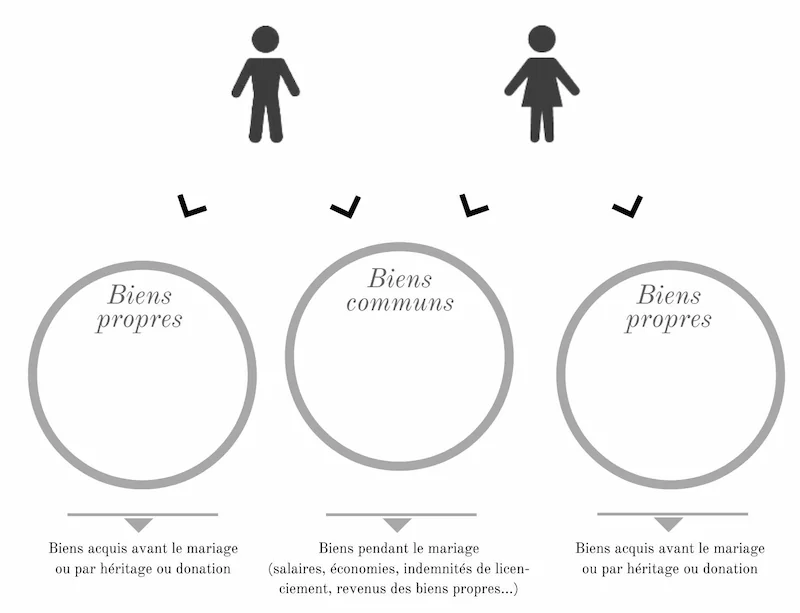
Under the statutory regime, all assets acquired after marriage are divided equally (50/50) between spouses. If one asset mass financed another when it should not have, it is entitled to a reimbursement called a "compensation claim" (récompense). For example, if personal funds finance 10% of a community property initially worth 100, and at the time of divorce the revalued property is worth 200, the community estate owes 20 to the personal estate that contributed to the purchase.
This mechanism differs from buying out shares under joint ownership (indivision), which follows separate legal rules.

Main residence, secondary homes, or rental properties.

Property Division Under the Statutory Regime (Without Marriage Contract)
Sale and Division of the Family Home
Selling the Property Following Separation
Attorneys frequently recommend selling common real estate during or after the divorce, or arranging for one spouse to buy out the other's share (soulte). The market value must be established through multiple valuations by certified estate agents. The Family Court Judge rules if the spouses cannot agree.
Note: if the family resides in a property exclusively owned by one spouse (separate property), the asset remains their exclusive property. However, during the divorce proceedings, the judge may grant temporary occupancy to the other spouse with the children.
Mortgage Repayments During Divorce
Typically, spouses sell the property and redeem the mortgage early. During the pre-sale period, the judge often orders the spouse retaining exclusive use of the home to pay the entire monthly mortgage as an occupancy indemnity (indemnité d'occupation). Otherwise, this indemnity generally corresponds to half the property's rental market value.
However, if this spouse has no income, the judge may rule that the spouse who vacated the home must continue servicing the mortgage. Arrangements must be tailored specifically to each family based on respective incomes, family circumstances, and child custody arrangements.
Notarial Liquidation Deed (État Liquidatif)
The état liquidatif is a formal notarial deed that officially divides the assets acquired during the marriage. This is known as the "liquidation of the matrimonial regime". Matrimonial liquidation applies in case of a regime change, death, or divorce. It is strictly mandatory for married couples owning real estate (under community or joint co-ownership / indivision).
In an uncontested mutual consent divorce, this notarial deed is annexed directly to the divorce agreement. In contested divorces, it is typically prepared by a notary after the final divorce judgment.
Dividing Rental Investment Properties
Experience demonstrates that maintaining real estate under joint co-ownership (indivision) after divorce is an endless source of litigation. This arrangement should be avoided except in rare cases. For instance, holding several rental investments jointly leads to constant friction (renovations, property insurance, local taxes, managing agencies, tenant selection, maintaining a joint account for rents, etc.).
Other Marital Assets (Non-Real Estate)
Bank accounts, life insurance policies, investments, and vehicles are systematically audited and divided in the liquidation deed by the notary and attorneys.
How Much Does Asset Division and Notarial Liquidation Cost?
These operations are formally finalized by a notary office. The French State levy (droit de partage) is 1.1% of the net divisible assets (after deducting marital liabilities and debts from total assets).
The notary's statutory fees (émoluments) are regulated by law under Article A 444-83 of the Order of February 26, 2016:
- From €0 to €6,500: 3.945%
- From €6,500 to €17,000: 1.627%
- From €17,000 to €60,000: 1.085%
- Above €60,000: 0.814%
Who Pays Debts During Divorce Proceedings?
While married and before the final divorce decree, spouses are jointly and severally liable (co-débiteurs) for debts incurred for the maintenance of the household and education of children. Conversely, spouses are not joint for personal debts or excessive/extravagant spending disproportionate to the family's standard of living.
Why Instruct a Lawyer for Matrimonial Asset Division?
Maître Quétand-Finet ensures your asset division is rigorously audited and fair:
- In mutual consent divorces, she conducts the liquidation negotiations with opposing counsel and defends your financial share.
- When a notary drafts the division deed, she reviews all calculations, compensation claims, and underlying hypotheses to safeguard your assets.
Her role is also to optimize costs, unblock a disputed liquidation in deadlock, protect your wealth, and facilitate fair settlement agreements.

By Claire Quétand-Finet Family & Divorce Lawyer - Versailles Bar Association
PhD in Private Law · +10 years of experience in family & divorce law · University Lecturer for continuous legal expertise
See also:
Fault-Based Divorce - Uncontested Divorce - Petitioning the Family Court Judge
Need Legal Guidance?
Contact us for a consultation on your property division and asset settlement
Request a Consultation